
1. DOSAGE
Recommended DCA daily dose is 20 mg/kg daily (milligrams per human body kilogram per day).
Calculation of dosage for a particular person is simple: just multiply your weight by 20 mg/kg and you will get daily DCA dose in milligrams.
For example – if the person weighs 75 kg:
75 kg x 20 mg/kg = 1500 milligrams daily = 1.5 grams of DCA daily (5 capsules of 333 mg or 3 capsules of 500 mg)
The weight of the person should be taken excluding overweight.
MINIMAL DOSE
Minimal therapeutically effective DCA daily dose is two times smaller – 10 mg/kg daily. Smaller amount is not recommended as the drug may have little to no effect.
MAXIMAL DOSE
In case there are no side effects, DCA dosage may be increased to 30-40 mg/kg daily.
In case of strong side effects daily dose should be reduced to 10-20 mg/kg daily.
2. MEASURING DCA POWDER
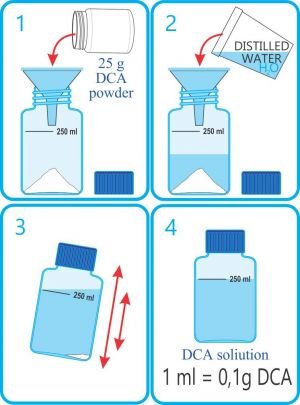
The most accurate way to measure DCA powder is by water solution. It is best to prepare a solution containing 0,1 g of DCA powder in 1 ml of water solution.
1. Put 25 grams of DCA into 250 ml bottle (alternatively 50 grams into 500 ml, or 100 grams into 1000 ml). WARNING: remove and dispose of the desiccant packet, if there is one inside.
2. Pour cool distilled water till it reaches the 250 ml point.
3. Close the bottle and shake it until the powder dissolves.
4. This way 1 ml of solution will hold 0,1g of Sodium Dichloroacetate
1 milliliter DCA solution = 0,1 gram powder DCA
| DCA solution, ml | 1 | 2 | 3 | 4 | 5 | 6 | 7 | 8 | 9 | 10 |
|---|---|---|---|---|---|---|---|---|---|---|
| DCA powder, g | 0,1 | 0,2 | 0,3 | 0,4 | 0,5 | 0,6 | 0,7 | 0,8 | 0,9 | 1,0 |
3. DCA SCHEDULE
DCA should be taken 2 times a day with food. One half in the morning, the second half in the evening.
For example, if a person weights 80 kg and takes 2 grams (6 capsules) daily, he should take 1 gram (3 capsules) with breakfast and 1 gram (3 capsules) with dinner.
During the first week of the treatment take smaller doses:
| Day | % of daily dose |
|---|---|
| Day 1 | 25% |
| Day 2 | 50% |
| Day 3 | 75% |
| Day 4 | 75% |
| Day 5 | 75% |
| Day 6 | Break |
| Day 7 | Break |
If using DCA doesn‘t cause any unwanted side effects, next week start taking the full dose.
There are two known schemes for DCA usage:
A) Take full daily doses of DCA for five days straight and then take a break for two days. Repeat this routine every new week. (old way)
B) Take full daily doses of DCA every day for two weeks and then take one week off. This scheme could be more beneficial when seeking a better antitumor effect. (new way)
4. THE DURATION OF TREATMENT
Best results are to be expected in stage 1, 2 and 3 cancer.
STAGE 1 – 2:
- Usually about 2 – 3 months, depending on the results.
- Take scans and tests often to monitor your cancer.
- Recurrence prevention: in case of remission, it is recommended to take DCA periodically (for about 6 weeks every 18 months or so). Tests should be taken, and, if there is a need, the frequency of DCA treatment may be increased.
STAGE 1, 2 or 3, IN CASE OF SURGERY WHERE ALL OR MOST OF THE TUMOR IS REMOVED:
- About 6 weeks before surgery (to localize the tumor) and about 8 weeks after (to prevent metastasis).
- Take scans and tests often to monitor your cancer.
- Recurrence prevention: in case of remission, it is recommended to take DCA periodically (for about 6 weeks every 18 months or so). Tests should be taken, and, if there is a need, the frequency of DCA treatment may be increased.
STAGE 3:
- Usually about 3 – 4 months, depending on the results.
- Take scans and tests often to monitor your cancer.
- Recurrence prevention: in case of remission, it is recommended to take DCA periodically (for about 6 weeks every 3-6 months or so). Tests should be taken, and, if there is a need, the frequency of DCA treatment may be increased.
STAGE 4:
- Take constantly. In case of positive results, depending on the situation, DCA may be taken in smaller doses and with longer breaks.
- Take scans and tests often to monitor your cancer.
- Healthy lifestyle is important.
5. SIDE EFFECTS
Side effects occur in about 45% of cases and are age-dependant (less expected in younger patients). They are reversible and should disappear shortly after stopping DCA treatment.
Neurological:
- Most common – peripheral neuropathy (hand and feet numbness or stiffness, hand tremor, sometimes – pain in arms and legs).
- Rare – light delusional behaviour and hallucinations.
Gastrointestinal:
- Heartburn, nausea, vomiting, indigestion. Pantoprazole may be taken as treatment.
Detailed information about side effects.
6. WHAT SUPPLEMENTS TO TAKE
To reduce or prevent neurological side effects, these supplements may be taken:
- VITAMIN B1 (Thiamine) – 50-300 mg daily (the most important supplement to reduce the chance of neuropathy. Vitamin B1 also provides additional anticancer properties)
- ALFA-LIPOIC ACID – 200-500 mg daily (do not take with chemo, wait 1 week after; do not take with radiotherapy, wait 2 weeks after)
- L-CARNITINE – 500-1500 mg daily
You may also take the supplements that help liver function:
- SILYMARIN supplements (for example: Carcil)
- PHOSPHOLIPIDS (for example: Essentiale forte)
Immunity boosters, other:
- VITAMIN D3 – start taking 3000UI daily and check blood level of 25-hydroxy vitamin D levels every month. Change dosage to achieve stable vitamin D level in normal range (40-60 ng/ml or 100-150 nmol/l)
- MULTIVITAMINS – make sure it does not contain copper
- SEA BUCKTHORN OIL
- SHIITAKE, REISHI and MAITAKE mushrooms
7. DCA AND CHEMOTHERAPY
For information about DCA interaction with specific chemotherapy drug, try searching the internet. Dcaguide.org will prepare more information on this subject in the future. It’s worth noting that clinics use this strategy and achieve satisfying results.
8. DCA AND RADIOTHERAPY
DCA may improve the effects of radiotherapy in some patients. Try searching on the internet for further information. Dcaguide.org will prepare more information in the future.
9. EFFECTIVENESS DEPENDING ON THE TYPE OF CANCER
It appears that DCA may have a positive effect on almost all types of cancer, though the effectiveness varies. Especially good response is observed in cases of: non-small cell lung cancer, breast cancer, colon and colorectal cancer, brain astrocytoma, glioblastoma, neuroblastoma, Non-Hodgkin’s Follicular Lymphoma, prostate, ovarian and other cancers.
Best results are to be expected in cases of stage 1, 2 and 3 localized cancer.
10. DIETARY RECOMMENDATIONS
Try eating more fresh fruits and vegetables, avoid sweets and animal fats. We advise you to check the internet for more information on effective diets when treating cancer. Till we publish new information, we advise you to eat a healthy diet for your overall health since food has an effect on the progression of the disease.
Can you take DCA with fenben? Been researching for a while and can’t seem to find anything contradictory. Any help would be greatly appreciated.
hello, we have been accepting CDA for 5 days now. since 2 days there is a tremor in the left hand. We take fenbindazole as well. I am sending you the conclusion of brain metastases, translated from Spanish. We also take corticoids. we do 2h distance. I sea for advice.Pulinen adenocarcinoma, cerebral targets, cognitive impairment, bradypsychic naming and word finding difficulties, from 5 days. No Fever Halagy, Simple Skull Diagnosis and Recommendations Compared to a previous study conducted in November 2022. A larger component of edema associated with left frontal metastases was observed, resulting in a larger mass effect, leading to a larger midline shift to the contralateral side, at this point 11 mm, due to an associated subfalcial hernia Herniation of the left temporal uncus was also seen secondary to the mass effect described above Dilatation of the occipital horn of the right lateral ventricle, already visible on a previous study, suggesting hydrocephalus at the level of the right frontal foramen of Monro, secondary to the metastases known at this level, with obliteration of the sulci already visible in the previous study. of limited evaluation without IV contrast, although no complications were observed. superadded No new ischemic or hemorrhagic lesions Inflammatory pansinus sinusopathy Conclusion: Increased vasogenic edema due to left frontal metastases, with larger contralateral subfalcial hernia Obstructive hydrocephalus and right frontal edema similar to previous, same metastatic study
My girl Daisy has a mast cell tumor on her right ear. She is about 50 lbs, so I ordered the 333 capsules and supplements. Should i try to split the capsule into half doses for morning/evening, or am I ok with giving her the one capsule once a day/ two weeks on – one week off? I did the calculator and it says one 333mg capsule, but #3 DCA schedule says twice a day. A 200-250mg cap would be ideal for my particular situation, going a little higher than recommended but lower than maximum…
Work for stage 4 pancreatic cancer?
Stage 4 Pancreatic cancer–does DCA work
I’m confused. The calculator based on mu weight recommends 4, 500 mg capsules and 6, 333 mg capsules. Is that per day?
My weight is 73 Kg. How many capsules can I take daily at the maximum if there are no side effects?
If I experience any side effects then what would be the recommend daily dosage of capsules?
This way I can have a better idea. Not made up my mind if I want the 333 mg capsules or 500 mg yet.
Thanks
Hello,
80 kg male, resected localized liver tumor. Planing to start DCA powder after chemo finishes.
For 80 kg, daily dosage 1600mg DCA powder.
So,
I will mix 1600mg DCA with 16 ML water, shake well and drink 8 ml after breakfast, 8 ml after dinner.? 2 week on 1 week off cycle at least 2-3 months? Is it right?
Solution must prepare daily?
Thank you.
Stage 4, TNBC. Tumor size 1.5 cm at the liver, and some 2-3 mm other lesions.
51 kilograms, asymptomatic
Ca 15.3 in 12.5, glicemia 73, insulin 2.43
In healthy Keto diet, plant base, plus HBTO on her 3 week, metformine 1000 xr daily
Plaquitaxel/carboplatin every 3 weeks, in her 3 round as we speak
And just started 500 mg of DCA
PET-CT coming up in 5-6 weeks
My questions are:
1. Can the DCA give an false negative or false positive on the PET CT?
2. When should DCA be stopped before a PET-CT?
3. Is DCA safe when taking with chemotherapy or HBOT ?
Thanks
Dear JC,
Thank you for your message. This is a great question. Since cancer exhibits the Warburg effect (abnormally large glucose uptake), in PET-CT imaging the tumors in the body start to shine. This is a really clear way to see where the cancer is localized, how active it is, whether it has spread and etc.
1) DCA should not affect the results of a PET-CT scan. Unless the tumor is dead and non-functioning anymore. Once the tumor is completely stopped, it will not emit any signals of intensified metabolism.
2) DCA can be taken continuously before and after the PET-CT scan. However, if you are really concerned that DCA will somehow affect the PET-CT scan, you can take a break from DCA administration 1-2 days before the scan and resume it as soon as its finished.
3) DCA should be avoided when you’re in the hospital receiving active treatment and about 4-5 days after receiving the last chemotherapy pill or i/v administration. The reason for this is that we still do not know which chemotherapies display synergism and antagonism with the Sodium dichloroacetate treatment. We will update you with this information as soon as we have prepared the list. HBOT (Hyperbaric oxygen therapy) does not seem to interfere with the DCA treatment, they can both be done simultaneously.
Hi can you take this in conjuction w other targetted drugs like tagrisso and off label ones like fembenzdazole?
I was curious about taking the alpha lipoic acid. With my Keytruda infusion?
Does this treatment show to be helpful with Chronic Lymphocytic Leukemia?
Have there been reported cases of tnbc been beaten down taking this stuff?
My brother is a high lactic acid mitochondria, 33 years old this year 48 kg, how can I use this product?
Can dca be applied topical with dmso for a tumor or lets say a bladder wash with dmso assuming the tumors locations are known? If so, i have 25g of 99.9% purity , how can i measure topical usage?
Hi, thank you for creating this page, it is very useful and helpful for someone like me who has cancer patients at home, it’s just happen to be my cancer patient is my cat. I’m wonder for the dosage recommendation does it works on dogs, cats and small animals too? And how about the supplements recommendation does it also works them too?
Thank you!
Thank you dca guide. You are more than helpful. I really appreciate the extensive information you have provided. Thank you and I look forward to the CFS topic page.
Could you add more information about treatment for Chronic Fatigue? Thanks
Dear Susan,
CFS (Chronic Fatigue Syndrome) has been added to the Dosage Calculator. Separate page for the CFS topic is being prepared.
Hi please can you tell me where to buy this my husband has stage 4 cancer. He is on his 3rd round of toxic chemo. Thank you
Thank you for your question. Please visit the “Suppliers” section on the top of the page to find out more information on the global DCA vendors.